| The
Polar Ice cap is melting. Changing the Horizon. History dissolves with
the vanishing ice.
Catrin
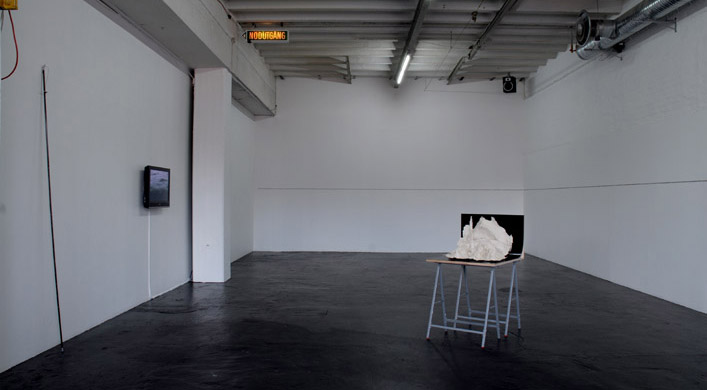
Andersson, sound installation Triangulating Source of Tremor (2008)
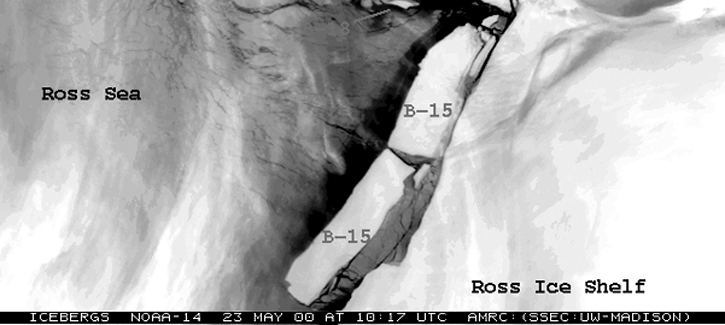
is based on the American geophysicist Douglas MacAyeal research from
Antarctica and the breakup of the world's largest iceberg B15A from
the Ross Ice Shelf. Recorded with seismic recording equipment, which
includes low-frequency quakes sound gives access to a magnificent natural
phenomenon, the crossroads of absolute beauty and devastation, which
otherwise can not be perceived by the human ear. The soundtrack´s
almost fictional character also reflects how we unconsciously store
impression by popular culture / film, how it spread to and affect our
view of the real.
Anna Johansson,
Freelance curator
The B15 Antarctic iceberg was the world's largest recorded iceberg,
with an area of over 11,000 km2 it was larger than the island of Jamaica.
It calved from the Ross Ice Shelf in March 2000, breaking up into several
pieces in 2002 and 2003.
Sound piece Triangulating Source of Tremor (2008) contains
borrowed audio clips from the field work of Glaciologist Douglas MacAyeal,
professor in the University of Chicago's Department of Geophysical Sciences.
His work is oriented toward "field-data collection and processing”.
My approach to climate related science uses this field data as the means
to establish proper, rational models of the physical processes governing
climate, says Prof. Douglas MacAyeal.
The sound piece contains audio tracks what humans would hear if they
could sense low-frequency signals detected by the seismometer on iceberg
B15A during its break-up. The sound clip contains speeded-up signals
recorded by the seismometer while the pieces of B15A were jostling and
colliding the day after they broke off the main iceberg. The title Triangulating
Source of Tremor is retrieved from the approach the researchers used
to locate each of the quakes/sounds during the breakup of iceberg B-15A
from the Ross Shelf in Antarctica. To find out how the icebergs produce
the noises, Prof. Douglas MacAyeal and colleagues constructed a network
of seismographs on iceberg C16, which at the time was aground in the
Ross Sea and adjoining to B15A. (Triangulation = determination of a
point P's position in relation to two reference points, Q and R, and
the carefully measured the distance (baseline) between the reference
points). Some of the quakes occurred when B-15A iceberg broke off and
collide with the iceberg of C 16 in a zone of only 5 kilometres, second
quake occurred when ocean swell made the ice scrap against each other.
Quakes are not audible to the human ear, but becomes audible through
the recording with a seismometer, which since the sound is played at
high tempo.The seismometer record showed movement in the iceberg starting
12 hours before the iceberg broke up and continuing for three days following.
Despite prevailing mild conditions, the iceberg moved half an inch up
and down and four inches from side to side. The research team suspected
ocean swell as the cause
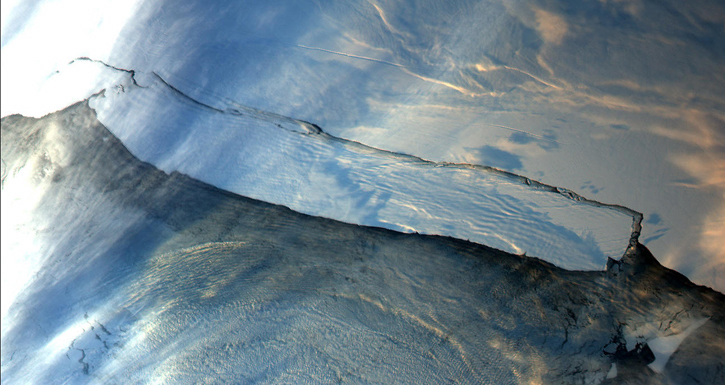
B-15A, was the world's largest free-floating object—it was 122
km (76 miles) long, 27 km (17 miles) wide, and covered an area of 3,100
km2 (1,200 mile2, or approximately the size of Luxembourg). In November
2003, after the separation from B-15J iceberg, B-15A drifted away from
Ross Island on the open waters of the Ross Sea.
Catrin Andersson,
2011
All
material used by permission from Douglas MacAyeal
Audio courtesy of Douglas MacAyeal and Olga Sergienko.
Text in Swedish:
Titeln hämtas ur det tillvägagångssätt forskarna
använde för att lokalisera vart och hur skalven/ljuden uppstod
under uppbrottet av isberg B-15A från Ross Shelf i Antarktis.
(Triangulering = bestämning av en punkt P:s position utifrån
två referenspunkter, Q och R och det noggrant uppmätta avståndet
(baslinjen) mellan referenspunkterna). En del av skalven uppkom då
isberget B-15A bröts loss och kolliderar med isberg C 16 i en zon
på endast 5 kilometer, andra skalv uppstod då det dagliga
tidvattnet gjorde att bergen skrapar emot varandra. Skalven är
inte hörbara för det mänskliga örat men bli hörbara
genom inspelning med en seismometer, som sedan speeadas upp.
Catrin Anderssons ljudverk Triangulating Source of Tremor
(2008) är baserat på den Amerikanska Geofysikern Douglas
MacAyeal forskning från Antarktis och uppbrottet mellan världens
största isberg B15A och "Ross Ice Shelf". Inspelat med
seismologisk inspelningsutrustning som upptar lågfrekventa skalv
ger ljudet tillgång till en storslagen naturhändelse, i brytpunkten
mellan absolut skönhet och förödelse, som annars inte
kan uppfattas av det mänskliga örat. Ljudets närmast
fiktiva karaktär reflekterar också hur vi omedvetet lagrar
intryck från populärkultur/film, hur det färgar av sig
och påverkar vår uppfattning av det verkliga.
Text
(kursiv): Anna Johansson, Curator
Thanks to: Prof. Douglas R. MacAyeal
Department of Geophysical Sciences
University of Chicago
Listen
to sound tracks:
REVIEWS:
KONSTEN.NET
SYDSVENSKAN
|